Digital design / 2026
Digital Design & Verification.
Digital design coursework exploring simulation, timing constraints, gate level behavior, and verification coverage.
From a design to its behavior
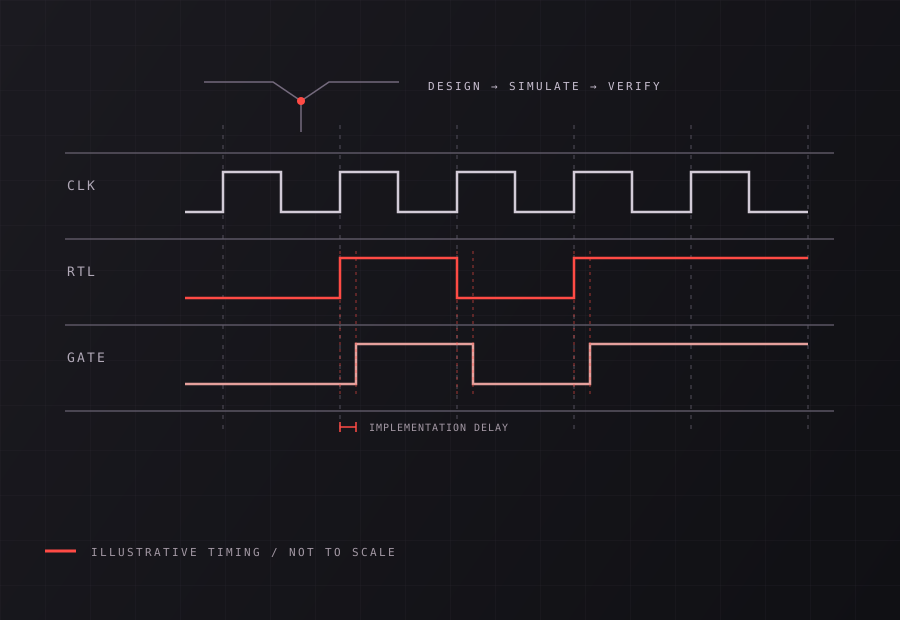
Digital design becomes more concrete when a functional model is compared with an implementation that includes gate delays. This coursework connects RTL simulation, timing constraints, gate level simulation, and verification.
What the work covers
- Running and comparing RTL and gate level simulations.
- Applying clock constraints and inspecting timing reports.
- Using delay annotation to study implementation behavior.
- Checking how input timing affects observed waveforms.
- Examining assertion, branch, statement, and toggle coverage.
The connection to my background
At Synopsys Lanka, I worked on power estimation and signoff validation for PrimePower. These laboratory exercises build on my interest in relating tool output to the behavior of the underlying design.
What I focus on
I am interested in what a result actually demonstrates: the assumptions behind a simulation, what timing information has been included, and which behaviors have been exercised by a test.
The waveform above is illustrative. It is not an exported simulation trace or a claim about a particular design’s timing.